

See how knowledge connects.

Follow any subject from Foundation to Year 12, in your state or territory.

EdDots Learning Map

See how to read the map
Year levels

Each learning area is listed with its Year 11 and 12 subjects, such as Physics under Science. The subject buttons below change the subject too.

Subject ladder

How to read this map

Connect the dots in your learning.

The Learning Map is the spine of your learning. Follow this example to see how to read it, then try the map above.

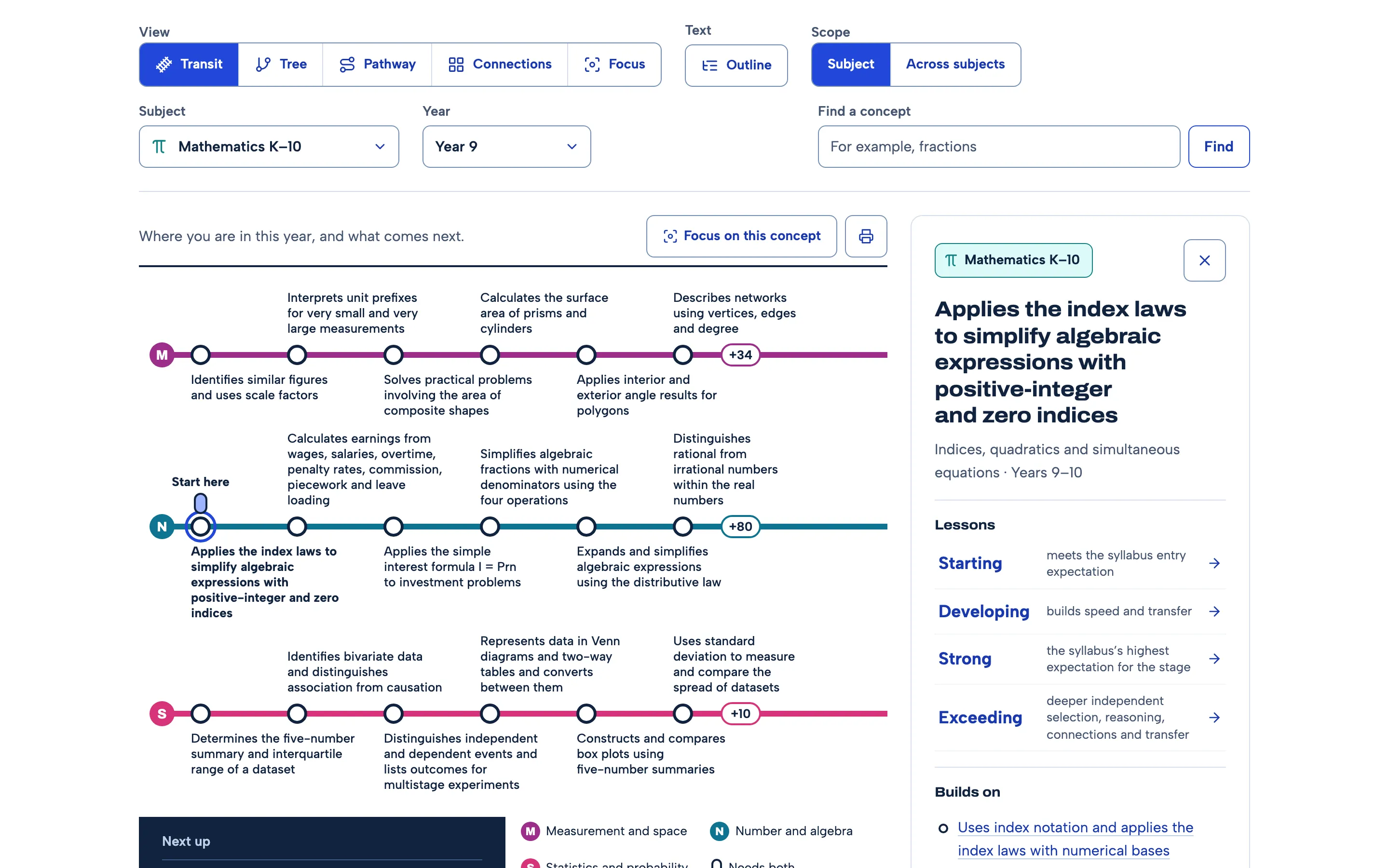
Example: Year 9 Mathematics · Transit view

Explore the Learning MapExample view

Choose a view above, or read the steps below.

Choose where to begin.

Choose a subject and year, or search for a concept. The map shows the ideas in that part of your learning.

Read the dots and lines.

Each dot is a concept. Coloured lines group related ideas into strands. Select a dot to open its details.

Follow the learning.

See what an idea builds on and where it leads. When lessons are available, choose a level to continue learning.

Try the map ↑

Lessons in Mathematics K–10, Year 5

Open a lesson to see its parts and levels. Select View example to try one level. Complete lessons need a learning subscription.

Mathematics K–10 · Year 5

15 lessons in this selection

Learning Map for Mathematics K–10 · Year 5 15 concepts · 4 topics · builds on 10 concepts from other years

Each concept of Mathematics K–10 · Year 5, and what it builds on, is drawn in the map above.

Sequence: NSW syllabus, as used on the learning platform for Mathematics K–10. For NSW, read each concept beside your state or territory’s official curriculum.

Fractions and decimalsNumber and algebra

Choose a lesson to see its structure.

Recognises and names unit fractions of shapes and collectionsStructure
  1. Introduction
  2. Prerequisite review
  3. The idea
  4. Worked examples
  5. Practice set
  6. Common errors
  7. Extension
  • StartingLearning subscription
  • DevelopingLearning subscription
  • StrongLearning subscription
  • ExceedingLearning subscription
Study this concept
Finds equivalent fractions using models and multiplicationStructure
  1. Introduction
  2. Prerequisite review
  3. The idea
  4. Worked examples
  5. Practice set
  6. Common errors
  7. Extension
  • StartingView example
  • DevelopingLearning subscription
  • StrongLearning subscription
  • ExceedingLearning subscription
Study this concept
Adds and subtracts fractions with the same denominatorStructure
  1. Introduction
  2. Prerequisite review
  3. The idea
  4. Worked examples
  5. Practice set
  6. Common errors
  7. Extension
  • StartingLearning subscription
  • DevelopingLearning subscription
  • StrongLearning subscription
  • ExceedingLearning subscription
Study this concept
Adds and subtracts fractions with unlike denominatorsStructure
  1. Introduction
  2. Prerequisite review
  3. The idea
  4. Worked examples
  5. Practice set
  6. Common errors
  7. Extension
  • StartingLearning subscription
  • DevelopingLearning subscription
  • StrongLearning subscription
  • ExceedingLearning subscription
Study this concept
Reads and orders decimals to thousandths using place valueStructure
  1. Introduction
  2. Prerequisite review
  3. The idea
  4. Worked examples
  5. Practice set
  6. Common errors
  7. Extension
  • StartingLearning subscription
  • DevelopingLearning subscription
  • StrongLearning subscription
  • ExceedingLearning subscription
Study this concept
Adds, subtracts and multiplies decimalsStructure
  1. Introduction
  2. Prerequisite review
  3. The idea
  4. Worked examples
  5. Practice set
  6. Common errors
  7. Extension
  • StartingLearning subscription
  • DevelopingLearning subscription
  • StrongLearning subscription
  • ExceedingLearning subscription
Study this concept
Link to this topic
Area, volume and anglesMeasurement and space

Choose a lesson to see its structure.

Uses formulas to find the area of rectangles and trianglesStructure
  1. Introduction
  2. Prerequisite review
  3. The idea
  4. Worked examples
  5. Practice set
  6. Common errors
  7. Extension
  • StartingLearning subscription
  • DevelopingLearning subscription
  • StrongLearning subscription
  • ExceedingLearning subscription
Study this concept
Calculates the volume of rectangular prismsStructure
  1. Introduction
  2. Prerequisite review
  3. The idea
  4. Worked examples
  5. Practice set
  6. Common errors
  7. Extension
  • StartingLearning subscription
  • DevelopingLearning subscription
  • StrongLearning subscription
  • ExceedingLearning subscription
Study this concept
Measures and draws angles with a protractorStructure
  1. Introduction
  2. Prerequisite review
  3. The idea
  4. Worked examples
  5. Practice set
  6. Common errors
  7. Extension
  • StartingLearning subscription
  • DevelopingLearning subscription
  • StrongLearning subscription
  • ExceedingLearning subscription
Study this concept
Plots and reads points in all four quadrants of the Cartesian planeStructure
  1. Introduction
  2. Prerequisite review
  3. The idea
  4. Worked examples
  5. Practice set
  6. Common errors
  7. Extension
  • StartingLearning subscription
  • DevelopingLearning subscription
  • StrongLearning subscription
  • ExceedingLearning subscription
Study this concept
Link to this topic
Analysing dataStatistics and probability

Choose a lesson to see its structure.

Calculates the mean, median, mode and range of a data setStructure
  1. Introduction
  2. Prerequisite review
  3. The idea
  4. Worked examples
  5. Practice set
  6. Common errors
  7. Extension
  • StartingLearning subscription
  • DevelopingLearning subscription
  • StrongLearning subscription
  • ExceedingLearning subscription
Study this concept
Interprets line graphs and two-way tablesStructure
  1. Introduction
  2. Prerequisite review
  3. The idea
  4. Worked examples
  5. Practice set
  6. Common errors
  7. Extension
  • StartingLearning subscription
  • DevelopingLearning subscription
  • StrongLearning subscription
  • ExceedingLearning subscription
Study this concept
Link to this topic
ChanceStatistics and probability

Choose a lesson to see its structure.

Describes chance using words such as likely, unlikely and impossibleStructure
  1. Introduction
  2. Prerequisite review
  3. The idea
  4. Worked examples
  5. Practice set
  6. Common errors
  7. Extension
  • StartingLearning subscription
  • DevelopingLearning subscription
  • StrongLearning subscription
  • ExceedingLearning subscription
Study this concept
Assigns probabilities to simple events as fractionsStructure
  1. Introduction
  2. Prerequisite review
  3. The idea
  4. Worked examples
  5. Practice set
  6. Common errors
  7. Extension
  • StartingLearning subscription
  • DevelopingLearning subscription
  • StrongLearning subscription
  • ExceedingLearning subscription
Study this concept
Link to this topic
Curriculum details for Mathematics K–10

NSW school sequence.

Stage 3 in the NSW source sequence · Years 5–6.

The Mathematics K–10 collection follows its named source sequence. For New South Wales, read each concept beside your state or territory’s official curriculum.

In Mathematics K–10, some source stages span two years and share lessons; choose a topic within the selected year level and revisit its foundation explanations when needed.

All subjects

See all subjects