
Learn concepts. See how they connect.
The Learning Map shows what each concept builds on and where it leads. Each lesson teaches it step by step, then you practise.
EdDots Learning Map · EdDots Notebook

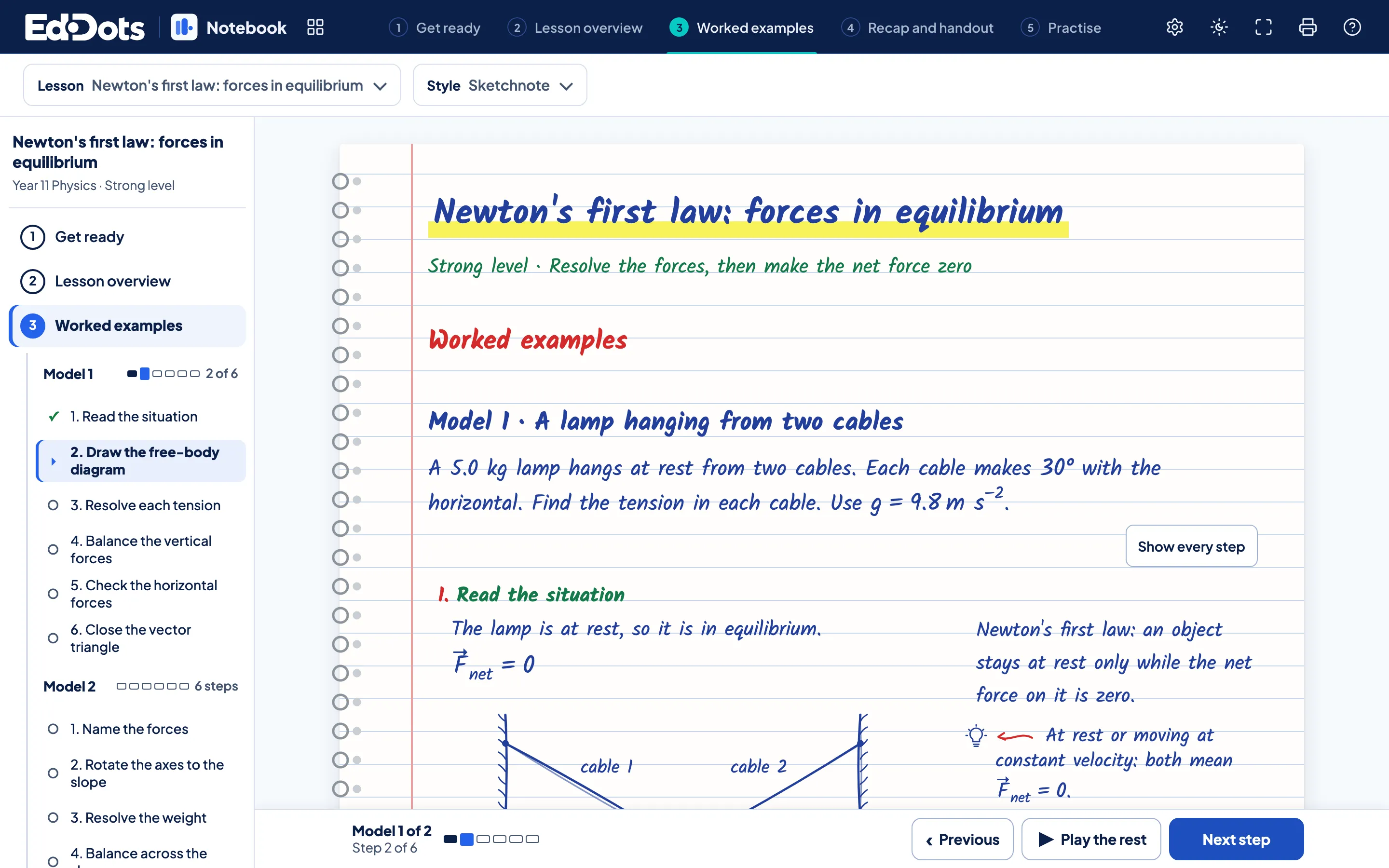
Five parts in the Notebook.
The example lesson reviews what you know, teaches the method and gives you questions to practise.
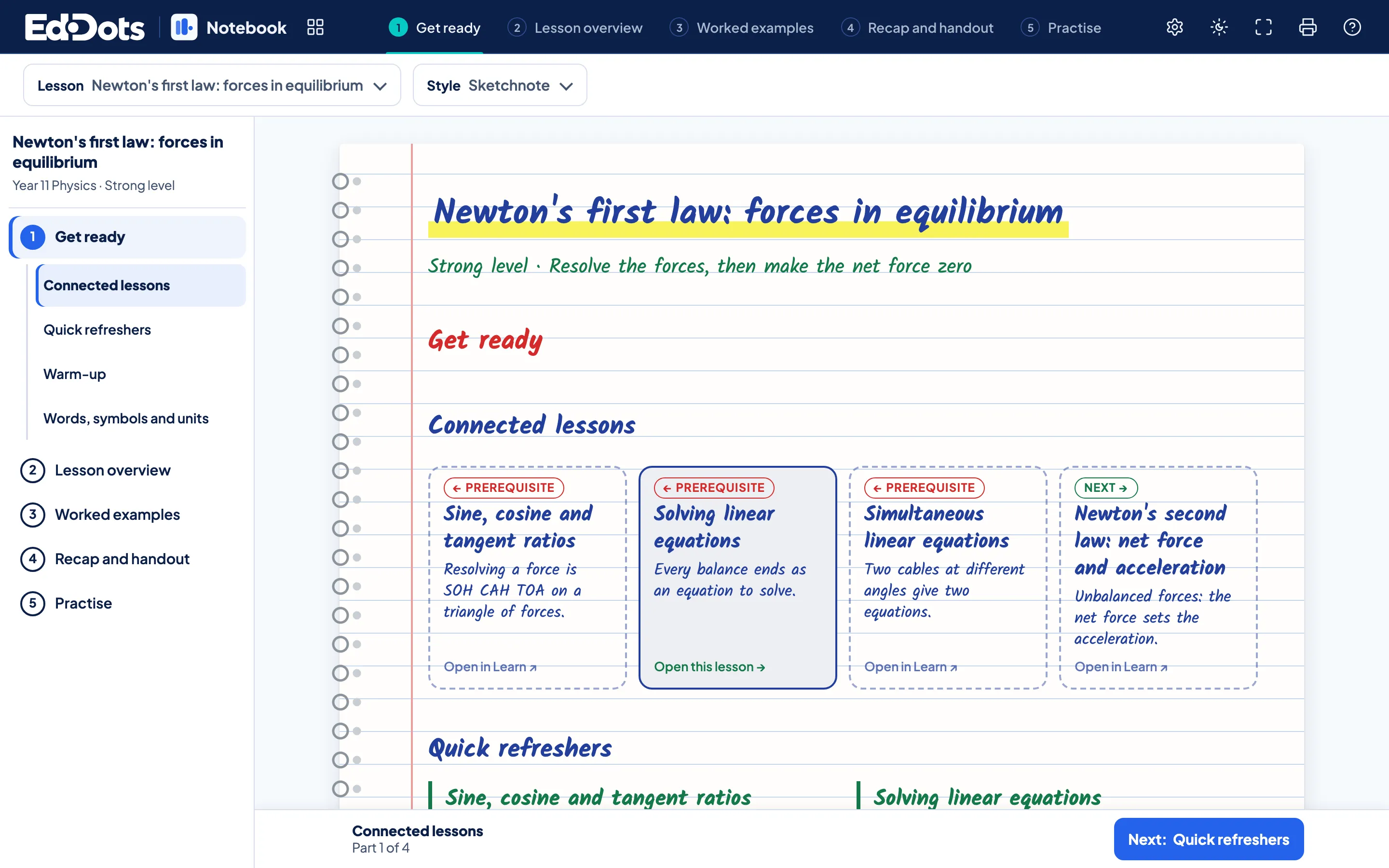
Get ready
Refreshers, a warm-up and key words.
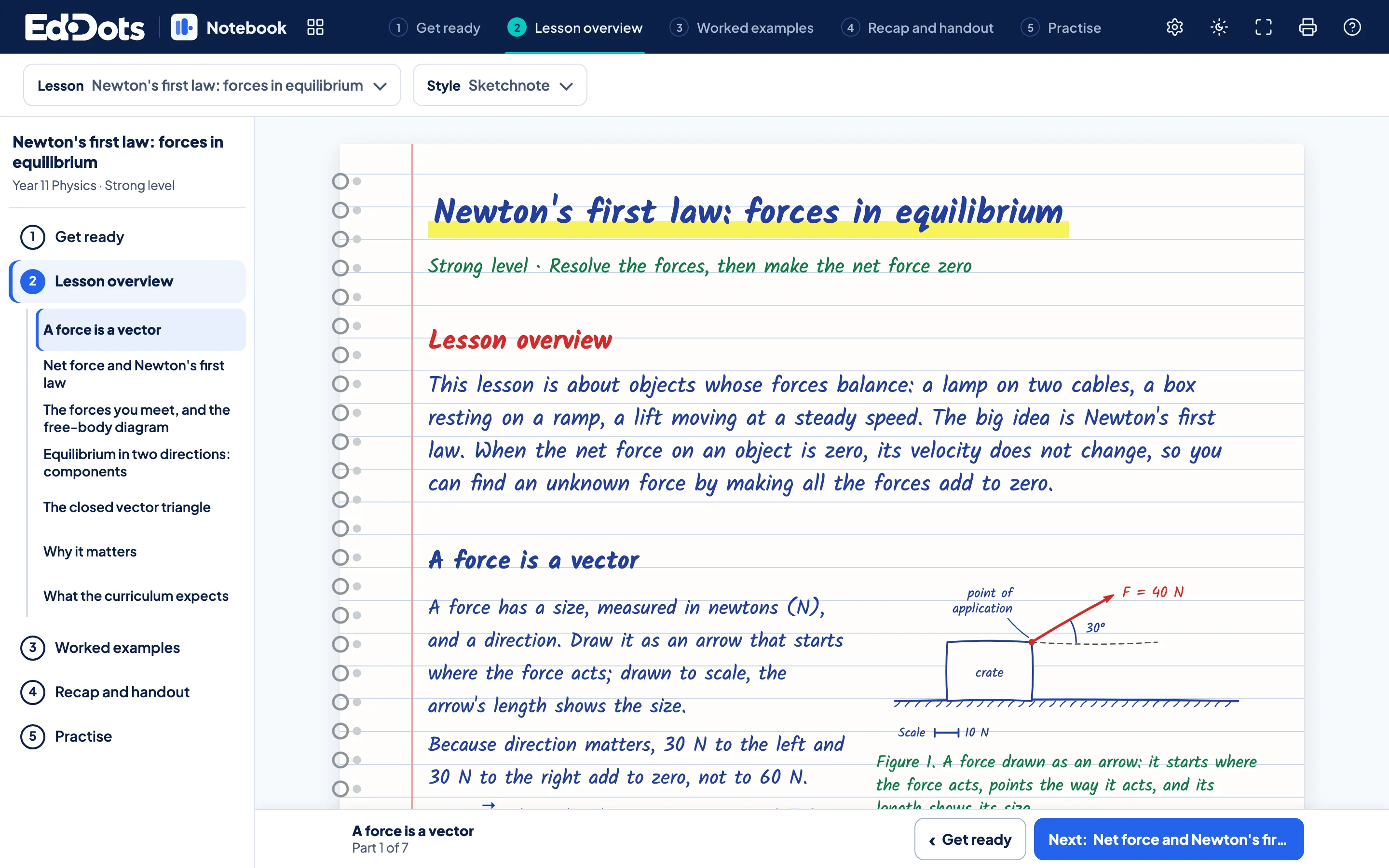
Lesson overview
The big idea and why it matters.
Worked examples
Two models, each step with its reason.
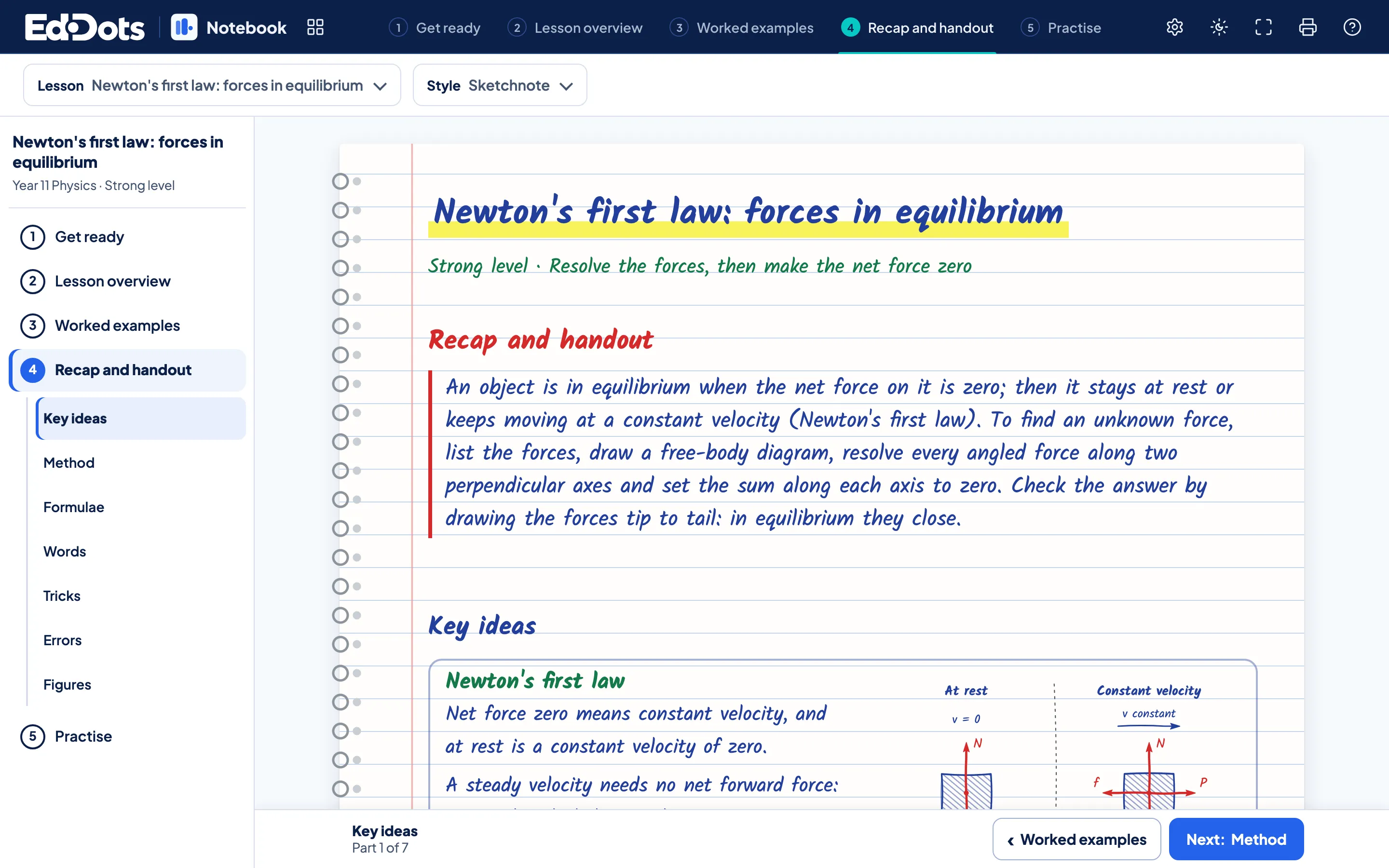
Recap and handout
The key ideas on one sheet.
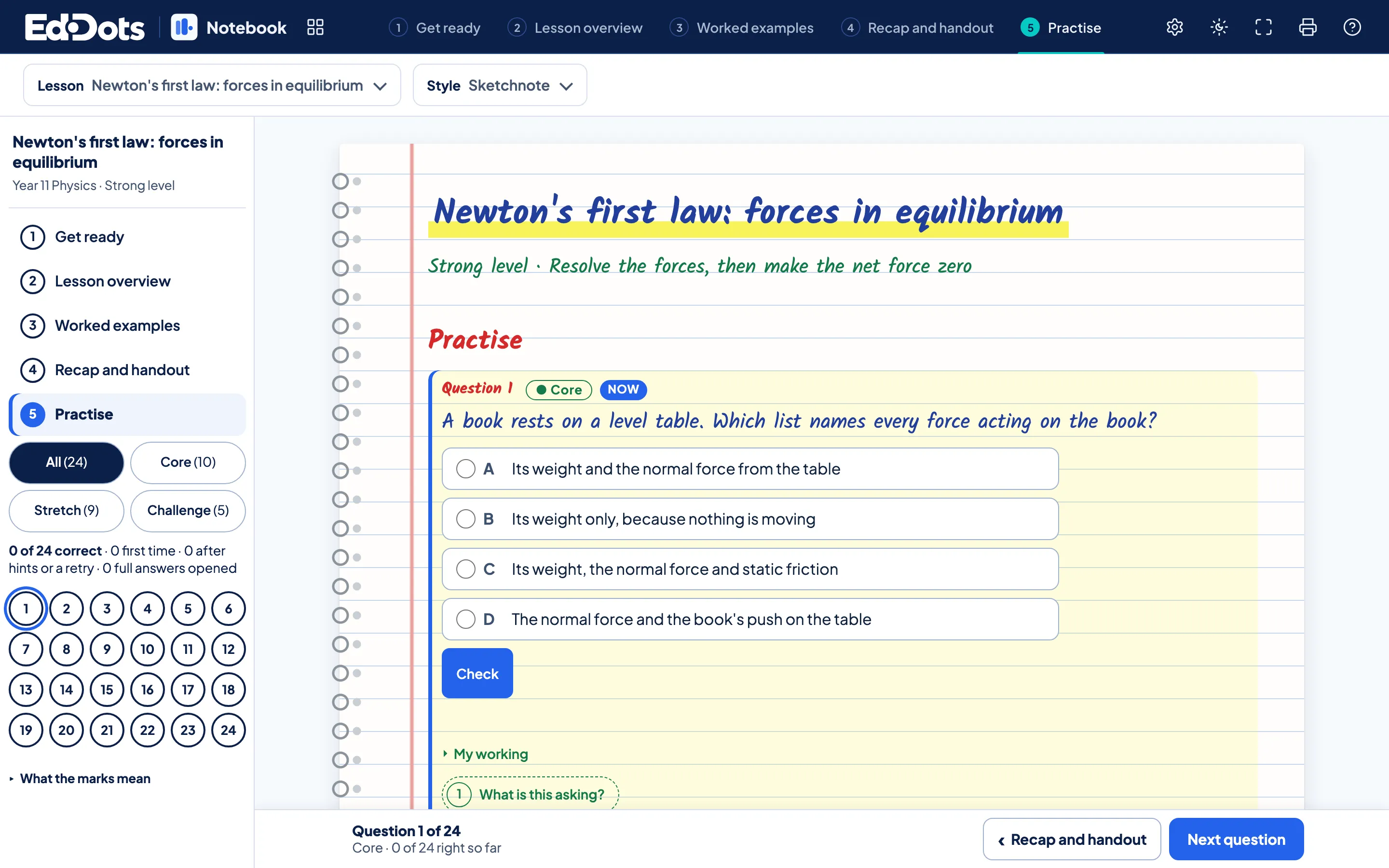
Practise
Graded questions, with hints.
See what each concept builds on.
Year 8 Mathematics. Open a concept to see what it needs.
Next up
- Measurement and space
- Number and algebra
- Statistics and probability
- Needs both
Know what to learn next.
Try a lesson, explore the Learning Map, and compare plans.
Try a free lesson
Open to everyone.
A free account
Under 18, a parent or guardian creates it.
Explore the Learning Map
See concepts and their connections.
Explore plans
Compare the subjects included in each plan.
Try a lesson together
Open to everyone.
A family account
Add each child.
Explore plans
Compare Focus, Plus and Complete.
Explore together
See concepts and lessons on the Learning Map.
Why it works.
Each part follows well-tested teaching research.
Ready whenever you are.
Open a lesson whenever it suits you.
How we know
Open the free Notebook example to explore a lesson in your browser. See plans and prices.
The method, step by step.
Worked examples first, before solving alone.
How we know
Each lesson opens with a short review of what it builds on, then sets out the method in small steps with worked examples, before any practice. This follows the worked example effect (NSW CESE, 2017; Sweller and Cooper, 1985) and the principles of explicit teaching (Rosenshine, 2012; AERO, 2025). Diagrams sit beside the words (Pashler and others, 2007). As a learner moves up the levels, practice asks for more independent problem solving.
Practice that builds up.
Practise with hints and worked answers.
How we know
The Notebook example includes questions that build on the lesson. Research on practice finds a high success rate during practice works best (Rosenshine, 2012), and that a high bar before moving on to the next level matters (Evidence for Learning; evidence rated low). Testing yourself and spacing practice over time are among the most useful study techniques (Roediger and Karpicke, 2006; Dunlosky and others, 2013).
A clear lesson structure.
Follow five parts in the Notebook example.
How we know
The Notebook example brings together Get ready, Lesson overview, Worked examples, Recap and handout, and Practise.
For your year.
Kindergarten to Year 12, and adult study.
How we know
The Learning Map organises concepts by subject and year. EdDots is independent of education departments and curriculum authorities.
Choose a plan.
Compare Focus, Plus and Complete.
How we know
The pricing page shows the planned monthly and yearly options and the subjects included in each plan. See plans and prices.
See how ideas connect.
Explore concepts on the Learning Map.
How we know
The Learning Map shows relationships between concepts, so you can see what an idea builds on and where it leads.
Print your lesson.
Choose the pages you want to print.
How we know
The Notebook example offers print and PDF options, including lesson and practice pages.
These findings describe teaching methods in general, and the researchers and organisations named are cited as their sources.
Research we cite
- NSW Centre for Education Statistics and Evaluation (2017). Cognitive load theory: Research that teachers really need to understand.
- Sweller, J. and Cooper, G. A. (1985). The use of worked examples as a substitute for problem solving in learning algebra. Cognition and Instruction, 2, 59–89.
- Rosenshine, B. (2012). Principles of Instruction. American Educator, Spring 2012, 12–19.
- Australian Education Research Organisation (2025, updated 2026). Teach explicitly.
- Pashler, H. and others (2007). Organizing Instruction and Study to Improve Student Learning (NCER 2007-2004).
- Evidence for Learning. Teaching and Learning Toolkit (reviews of 2021).
- Roediger, H. L. and Karpicke, J. D. (2006). Test-enhanced learning. Psychological Science, 17(3), 249–255.
- Dunlosky, J. and others (2013). Improving students’ learning with effective learning techniques. Psychological Science in the Public Interest, 14(1).